News

Newsletters & Updates

Follow developments in the world of Peppol e-invoicing in Slovakia

Article

How E-Invoicing works in practice

From issuing an invoice via the Digital Postman to receipt

In the previous article, we explained the legislative obligations introduced from 1 January 2027 by the amendment to the VAT Act. However, many businesses still find it difficult to imagine how the entire exchange of documents will work in their day-to-day operations.

Are you wondering how an e-invoice is delivered step by step, what role the so-called Digital Postman plays, and what practical benefits it brings to your accounting processes? You will find the answers here.

How is an E-Invoice sent and delivered in 5 steps?

You can think of the e-invoicing process in much the same way as traditional mail: you write a letter, put it in an envelope, the postman collects it, checks the address and delivers it directly to the recipient’s mailbox. In the digital world, the process works in a similar way, but at lightning speed and with the highest level of security.

  • Invoice Issuance: The sender (supplier) generates the invoice in their invoicing, accounting or ERP software in the same way as before. The software converts the document into the standardised XML / Peppol BIS 3.0 data format.
  • Sending via the Digital Postman: The supplier’s system sends the e-invoice to its Digital Postman (Access Point).
  • Secure Transmission via the Peppol Network: The supplier’s Digital Postman establishes an encrypted connection with the customer’s Digital Postman and securely transmits the document.
  • Automatic Reporting to the Tax Authority: At the same time, the required data from the e-invoice is automatically transmitted in real time to the Slovak Financial Administration in the form of a TDD (Tax Data Document).
  • Receipt by the Customer: The customer’s Digital Postman delivers the e-invoice directly to the customer’s accounting software, where it is automatically recorded without the need for manual data entry.
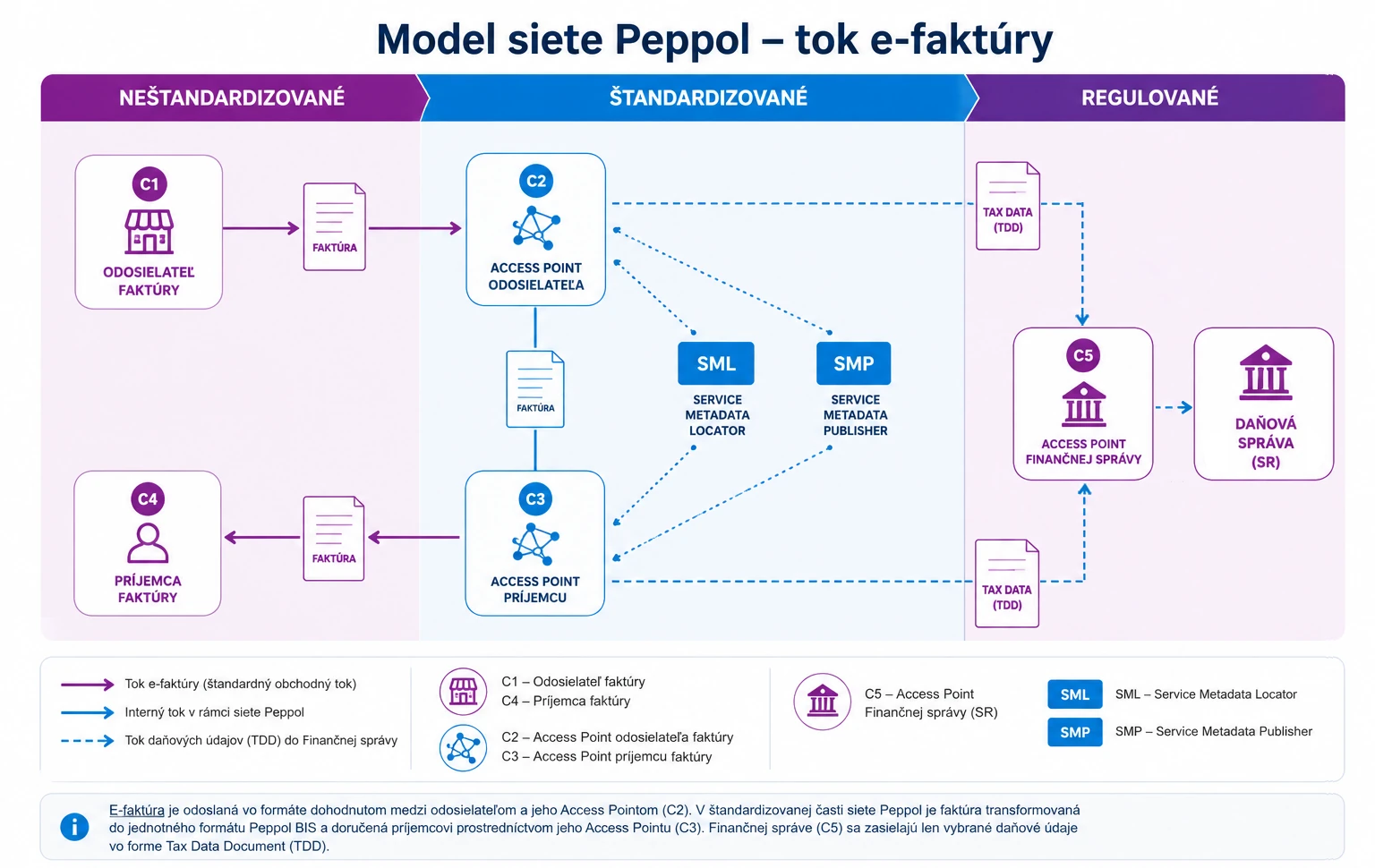
The Peppol network model — the e-invoice flow from the sender through the Access Points to the recipient, and the tax data (TDD) flow to the Slovak Financial Administration

What benefits does the E-Invoicing revolution bring to businesses?

Although the new legislation may at first seem like yet another administrative obligation, it will bring significant practical benefits to businesses in their day-to-day operations:

  • No more manual data entry: Invoice data is imported into the accounting system automatically, eliminating errors caused by manual data entry.
  • 100% guaranteed delivery: Thanks to the Digital Postman and MLS (Message Level Status) confirmation messages, you receive immediate confirmation that the invoice has been delivered to the customer. No more excuses such as “the invoice ended up in spam”.
  • Faster payment and approval: Immediate delivery shortens internal approval processes and helps accelerate invoice payment.
  • Lower operating costs: You save on printing, paper, envelopes, postage and the physical storage of document binders.
  • Fewer reporting obligations in the future: The continuous transmission of data to the Slovak Financial Administration will eventually replace complex VAT reporting requirements, such as the VAT Control Statement and the EC Sales List.

Would you like to prepare your company for the new era of invoicing smoothly and stress-free? Discover our certified mib:Peppol solution.

In the next article, you will learn: Who is the Digital Postman and what is its role in the Peppol network?
Read more expand_more
Article

Electronic Invoicing in Slovakia from 1 January 2027

Key terms and obligations

Paper invoices stored in binders and ordinary PDF files sent by email are gradually being phased out in Slovakia. From 1 January 2027, a new obligation will come into effect that will fundamentally change the way Slovak companies communicate, manage their accounting and fulfil their tax obligations. Mandatory electronic invoicing (e-invoicing) for the B2B and B2G sectors ushers in a new era of automation and security.

What is an E-Invoice and why is a standard PDF not enough?

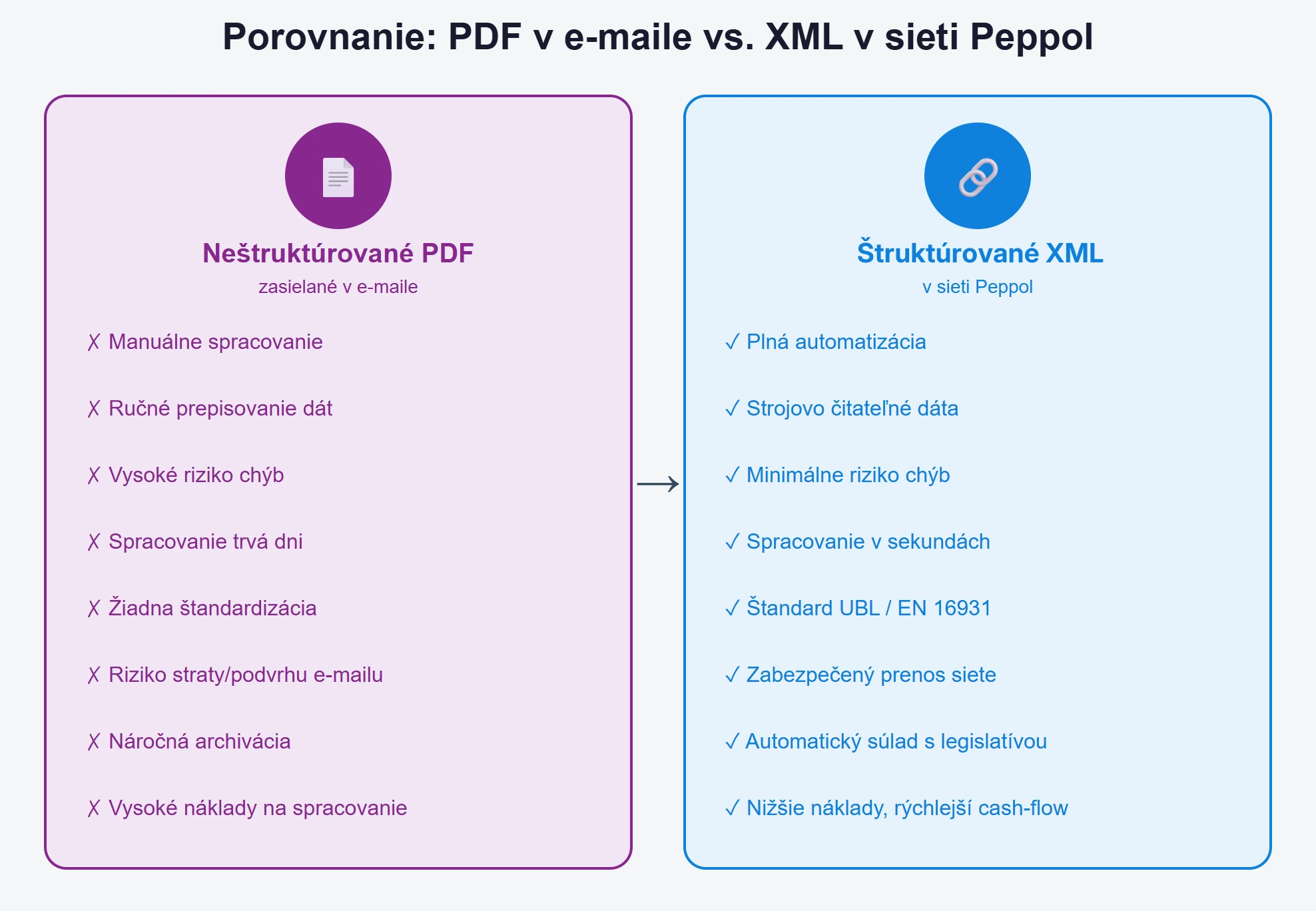
To this day, many businesses understand an “electronic invoice” to mean an invoice created in accounting software and sent by email as a PDF file. From 2027, however, this will no longer be sufficient.

A genuine e-invoice is a document issued, sent and received in a structured electronic format (XML). This format is designed to enable computers and accounting systems to read and process the data fully automatically, without the need for manual data entry.

Key terms you should know:

  • XML / Peppol BIS 3.0: A standardised data format that complies with the European standard (EN 16931) for electronic invoicing.
  • Peppol network: A secure international network designed for the electronic exchange of business and tax documents.
  • Peppol ID: A unique identifier for your company within the Peppol network (in Slovakia, derived from the company’s tax identification number – DIČ).
  • Digital postman (Access Point): A certified delivery service provider (such as MIBFORMA) through which your e-invoices are securely transmitted between the sender, the recipient and the state.
Comparative infographic: an unstructured PDF sent by email versus automated XML in the Peppol network

What obligations will apply to companies and businesses?

The legal framework for electronic invoicing is governed by Act No. 222/2004 Coll. on Value Added Tax, as amended. From 1 January 2027, the following clearly defined obligations will apply:

  • Obligations for Senders (Suppliers): If you are a VAT payer and supply goods or services to another business (a domestic B2B transaction), you will be required to issue invoices exclusively in XML format and send them via an approved channel (the Peppol network). This obligation applies to standard and summary invoices, credit notes, debit notes, tax documents for advance payments received, and self-billing documents. Invoice data will also be transmitted to the Slovak Financial Administration in real time.
  • Obligations for Recipients (Customers): Every company, business or self-employed person must be able to receive an electronic invoice in XML format – even if they do not issue e-invoices themselves or are not VAT payers, provided that they purchase goods or services from VAT payers.
  • Archiving Obligation: The law requires invoices to be retained for 10 years, while ensuring the authenticity of their origin, the integrity of their content and their legibility throughout the entire retention period.

How can you prepare today?

January 2027 may seem a long way off, but adapting internal processes and software takes time. We recommend checking whether your accounting or ERP system is ready, confirming with your software provider how Peppol integration is planned, and selecting a certified Digital Postman well in advance.

Would you like to check whether your system is ready for E-Invoicing?

Download our free Digital Postman Readiness Checklist, available for SAP, non-SAP and SAP DRC solutions.

In the next article, you will learn: How electronic invoicing will work in practice – from issuing an invoice and sending it via the Digital Postman to its receipt.

Read more expand_more
Webinar

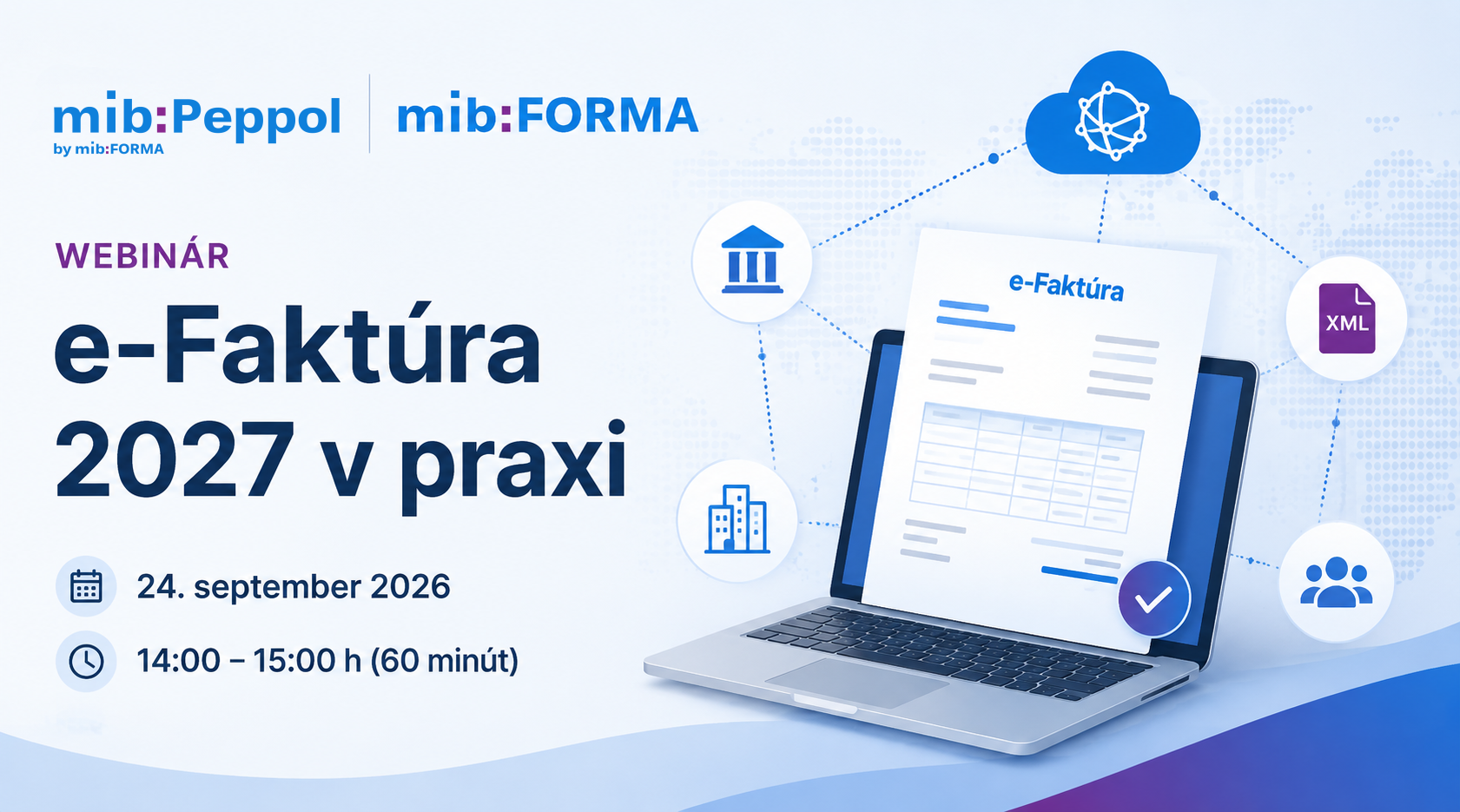
Webinar: e-Invoicing 2027 in practice

Webinar: e-Invoicing 2027 in practice

From 1 January 2027, electronic invoicing becomes mandatory for both the B2B and B2G sectors. The move to structured XML documents delivered over the Peppol network affects every VAT payer and calls for timely changes to processes in accounting and ERP systems alike.

We invite you to a MIBFORMA expert webinar, where you will see a working end-to-end solution. We will show you how to handle the different document exchange scenarios, how to connect several company systems, and how automated invoice processing saves substantial time and operating costs.

Webinar e-Invoicing 2027 in practice — 24 September 2026, 14:00 – 15:00

Event details

Date:

Thursday 24 September 2026

Time:

14:00 – 15:00 (60 minutes)

Format:

Online via MS Teams

Attendance:

Free of charge (prior registration required)

The webinar will be held in Slovak.

Programme

  1. A demonstration of a simulated e-Invoice processing run in both directions

    A step-by-step video demonstration of outgoing and incoming document processing in mib:Cockpit (directly inside SAP) and in the mib:Peppolbox monitoring portal (for SAP and non-SAP systems alike).

  2. A summary of what we have learned so far from ongoing project preparations

    Real-world experience from project delivery, integration setup and the verification of partners' master data.

  3. A special offer for implementation projects at companies that have not yet chosen a provider

Who is the webinar for?

The webinar is designed for chief financial officers (CFOs), IT managers, chief accountants, SAP specialists and company directors looking for a dependable technical solution for mandatory e-invoicing.

Read more expand_more
Issue 3

Newsletter 3: e-Invoicing & mib:Peppol Updates

Expanding our website with information on the mib:Peppol solution

During May we added information about our mib:Peppol product to the website www.mibforma.sk. This product handles the sending and receiving of invoices within SAP systems as well as the connection of non-SAP systems to our Access Point certified for the Peppol network in Slovakia.

SAP DRC Workshop for e-Invoicing

On 28 May 2026, an SAP partner meeting took place at the premises of SAP Slovensko s.r.o. The topic was the SAP DRC platform for e-Invoicing. SAP Slovensko is actively working on the localisation of the solution, which is already in use in other countries in the Peppol network. In the coming days and weeks, various webinars for partners and customers will take place. We received from our colleagues an overview of the current state of the solution, the legislation and the outlook for changes and steps in the near future. The meeting featured an active, constructive discussion, with SAP answering consultants' questions. In the coming weeks we expect further guidance from SAP on how to approach the solution so that every customer is ready in time.

Launch of the test and production SMP

During May, the Financial Administration of the Slovak Republic made available the functionality of both the test and production environments of the central SMP server (Service Metadata Publisher). This server acts as a directory of Peppol network participants registered in Slovakia. The sending Access Point reads data from the SMP server to determine where to deliver a document and whether the receiving Access Point can process the given document type. The registration of a participant is carried out by a Service Provider (Digital Postman), selected by the applicant on the Financial Administration website. The chosen Digital Postman is automatically notified of the registration by the Financial Administration.

Partners

We are seeking to extend our own commercial and delivery capacities with the capacity of a partner network. As part of this, we have agreed on cooperation with long-standing SAP partner JUST IT Solutions s.r.o. We believe this step will deepen both professional expertise and the availability of the solution to further customers.

What do we expect in June?

In June we are preparing the launch of a website dedicated exclusively to electronic invoicing. You will find Mibforma a.s. solutions for SAP users as well as customers with other ERP and invoicing systems. Demonstrations of the software for managing invoice sending and receiving, as well as the monitoring tool for tracking communication, will also be available. You will find answers to frequently asked questions about e-Invoicing and the latest news in this area. We will keep you informed about the website launch.

Read more expand_more
Issue 2

Newsletter 2: e-Invoice

Dear customers,
In the new edition of our newsletter, we bring you information about the most interesting events in the world of e-Invoicing for the month of April.

On Thursday, 23 April 2026, we organised the first of our planned webinars on the topic of e-Invoicing in Slovakia. The meeting took place via Microsoft Teams. We presented our mib:Peppol solution and our service offering for implementing mandatory e-Invoicing in participants' organisations.

We designed this solution to be as universal as possible, covering three areas:

  • 1 Integration of SAP systems into the Peppol network.
  • 2 Integration of non-SAP invoicing systems into the Peppol network — for both SAP customers and those using other systems.
  • 3 Operation of our own certified Access Point (AP) for sending documents via the Peppol network.

mib:Peppol is built on a set of proprietary cockpits (for SAP and for AP) communicating via API interfaces. We chose a solution based on proprietary components to ensure maximum independence and flexibility.

Alongside our own solution, we also offer customers the option of introducing e-Invoicing through SAP DRC implementation, whose localisation for Slovakia is currently underway at SAP.

Participants were also presented with the following topics:

  • legislative specifications
  • basic prerequisites for use
  • compatibility of solutions with customer systems
  • comparison of features of our solution and SAP DRC
  • comparison of business strategies, advantages and disadvantages

The webinar, which lasted approximately two hours, was attended by more than 70 participants. In addition to providing an overview of the solution, we answered many questions, and further communication is ongoing.

We completed certification, during which we successfully passed the following tests.

Complete PKI Migration Test Suite (G3)

Verifies that our Access Point is fully migrated to the new Peppol G3 PKI infrastructure and can securely communicate with partners using both G2 and G3 certificates.

Submission PKI Migration Test Suite (G3)

Confirms that the Access Point can send messages via the new G3 PKI infrastructure in a unilateral outbound communication scenario.

eDelivery Test Suite

Verifies compliance of the Access Point implementation with Peppol network specifications. In TLS grading verification we achieved the highest possible rating of A+.

BIS Billing 3.0 Test Suite

Confirms that the Access Point correctly processes and exchanges electronic invoices according to the Peppol BIS Billing 3.0 standard.

Slovakia Testing – Billing (3.0.20)

Verifies that the Access Point correctly sends BIS Billing 3.0 documents and generates and sends Slovak TDD documents to the Financial Administration.

Slovakia Testing – Self-Billing (3.0.1)

Confirms correct exchange of self-billing documents in the Peppol network and compliance with Slovak TDD reporting requirements.

We have created the mib:Peppolbox web application for monitoring Peppol transfers. It also offers a clear overview of all received and sent Peppol documents passing through the Access Point (invoices, corrective invoices, SK Tax Data Document, Message Level Status). It also includes transport logs from the Access Point — complete document lifecycle, document visualisation and export in XML and PDF formats, as well as an Integration REST API.

During May we will carry out end-to-end tests of our solution in an internal testing environment and at the end of the month we will conduct pilot tests in a customer system.

As part of our partner programme, we are also building a partner ecosystem, where we are currently in discussions with the first four partners regarding cooperation on the distribution and implementation of our mib:Peppol solution.

What's new in SAP DRC — The currently communicated release date for the Slovakia solution is October 2026 for on-premise versions and November 2026 for SAP S/4HANA Public Cloud. Until the official release by SAP, you can use the detailed SAP DRC Cloud Edition documentation on BTP.

Access to the SK SMP testing environment from the Financial Administration of the Slovak Republic is currently planned for the second half, or even the end, of May 2026. The exact date has not yet been finally confirmed and will depend on the readiness of the environment on the part of the Financial Administration.

Representatives of the Financial Administration of the Slovak Republic, at a joint meeting with economic software manufacturers and so-called Digital Postmen, provided information about a planned legislative amendment by the Ministry of Finance of the Slovak Republic. This amendment would abolish the obligation to report data to the Financial Administration for every received invoice on the part of the recipient's access point. The obligation to report data to the Financial Administration would be retained only for the sender's access point.

At the same time, this legislative change should abolish the obligation for property lessors (e.g., flat owners) to register in the Peppol network and receive invoices electronically.

Adoption of the legislative change is expected in autumn of this year.

On 22 April 2026, representatives of Mibforma a.s. attended the 19th General Assembly of the OpenPeppol organisation. This year's General Assembly confirmed that the Peppol network is experiencing unprecedented global growth and is transforming from a European tool into a key global digital infrastructure.

1  Record year 2025 in numbers

  • Member base: The number of members grew by nearly 40% to a total of 913.
  • Global reach: Among the new Peppol authorities are Slovakia, France, Nigeria, Taiwan and the UAE. The share of non-European members has grown to 30%.
  • Network activity: In 2025, more than 330 million documents were exchanged (an increase of 34%).

2  Strategic priorities and technical development

  • ViDA project (VAT in the Digital Age): Peppol is intensively preparing for new EU legislation through the ViDA pilot, in which 21 tax administrations are involved.
  • SML Insourcing: OpenPeppol is taking over management of the key infrastructure (SML) from the European Commission, thereby strengthening its independence.
Read more expand_more
Issue 1

Newsletter 1: SK PEPPOL Enablement Newsletter

Dear customers,
Based on your interest, we have prepared this first Newsletter on the topic of eInvoicing.

Our company was one of the first to be registered in the list of certified delivery service providers operating in the territory of the Slovak Republic.

The customer can choose one of two solution alternatives that we can implement. For SAP ERP customers preferring the standard approach, i.e. SAP Document and Reporting Compliance, we can provide both licensing and implementation. Licensing is on an annual basis in packages of 10,000 issued and received e-documents.

In the case of our solution, in addition to certification, we have implemented automatic sending and receiving of e-invoices in the Peppol network (Invoice, Credit Note including self-billing), document validation according to EN 16931 and Peppol BIS Billing 3, generation and sending of Tax Data Document (TDD) to the Slovak Financial Administration system, and sending of Message Level Status (MLS) delivery and validation confirmations.

You will find the road map in the attachment to this Newsletter.

On 20 April 2026 we organised a webinar at which we explained our approach to the solution and the implementation process.

The webinar covered:

  • Scope of functionality
  • Implementation process
  • Procedure in case of problematic situations
  • Costs associated with deploying and operating the solution

Date: 20.4.2026 at 09:00

Venue: MS Teams (the link to join was sent no later than one week before the event)

The webinar was conducted in Slovak.

Read more expand_more

Start with Peppol e-invoicing

Schedule a free consultation. We will help you choose the right implementation path and provide a detailed cost estimate.

What you get

  • Full readiness for Slovak eFaktúra legislation
  • Automated reporting to the Financial Administration of Slovakia
  • Document status tracking throughout the entire transfer
  • Secure processing according to Peppol PKI standards